From Jaane Tu Ya Jaane Na to The Café Across Carter Road, why we still love stories about unexpected connections, friendship, and falling in love when we least expect it.
There are some movies you don’t really grow out of.
You might watch them for the first time when you’re in college, revisit them a few years later, and suddenly find yourself relating to an entirely different character. The jokes are still funny, the songs still work, and somehow, the emotions hit a little differently. I remember “Jane ne kaha wo duniya hai” that song is still in my playlist till now as I noticed while I am writing this blog.
For me, Jaane Tu… Ya Jaane Na is one of those films.
Released in 2008, the film gave us Jai and Aditi, two people whose friendship was so familiar, so comfortable, that neither seemed to realise what everyone around them could already see. It wasn’t a story about extravagant declarations or people falling madly in love at first sight. It was about the little things: knowing someone’s habits, understanding their silences, being there without having to announce it, and occasionally being the last person to understand your own feelings.
And perhaps that’s why we still enjoy watching it, aren’t we?
There’s something particularly comforting about romantic stories that don’t rush to tell us what love is supposed to look like. Sometimes, it begins with friendship. Sometimes, with a conversation that goes on longer than expected. And sometimes, it begins with a complete stranger whose presence slowly becomes part of your everyday routine.
That last one is what got me thinking about a different kind of Mumbai love story.
One that begins across a road, with a yellow umbrella, a library café, and two people who don’t even know each other’s names.
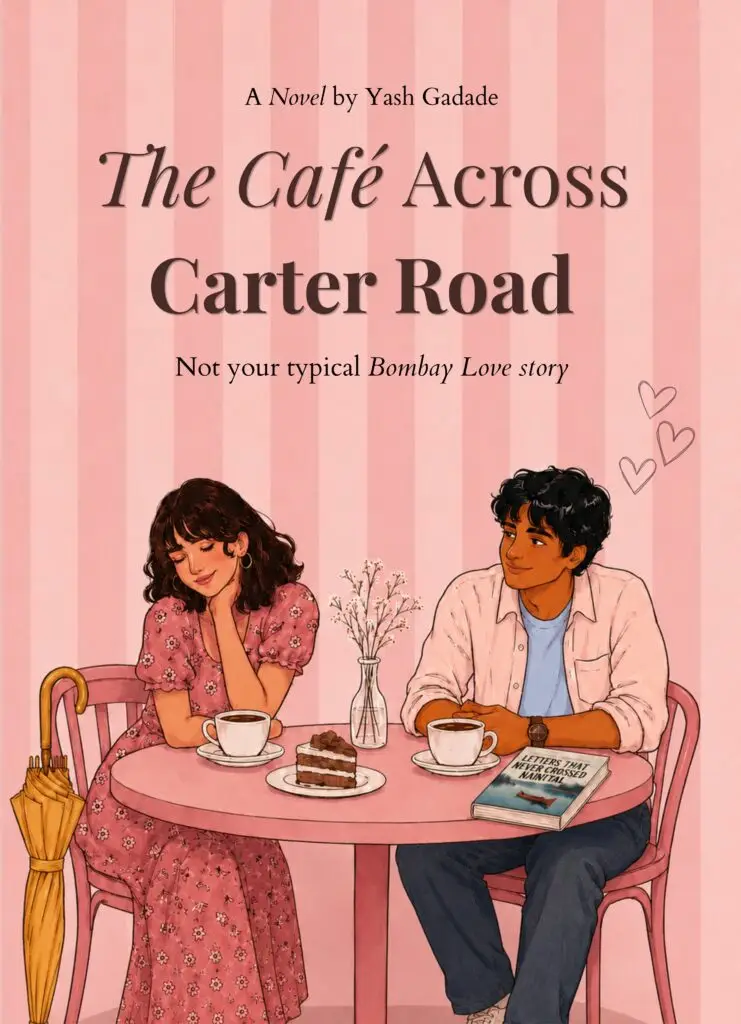
It’s called The Café Across Carter Road.
Why Jaane Tu… Ya Jaane Na Still Feels Like Our Kind of Romance

If you grew up watching Bollywood romantic comedies in the 2000s, you probably remember the kind of romance that films like Jaane Tu… Ya Jaane Na brought to the screen.
There was a certain innocence to it. People spent time together without constantly defining their relationships. A friendship could become something more, but the characters didn’t always have the emotional vocabulary to understand what was happening.
Jai and Aditi were not particularly complicated people. They were simply two individuals who knew each other exceptionally well, yet struggled to recognise what that familiarity meant.
What made the film memorable wasn’t just its romantic conclusion. It was everything that happened before it.
The conversations, the disagreements, the jealousy neither wanted to admit, and the realisation that sometimes the person you are looking for has been standing right beside you.
I think that’s an important reason why audiences continue to revisit these stories. We don’t necessarily remember every scene, but we remember how they made us feel.
And that’s something good romantic fiction tries to recreate.
Not necessarily the same characters or circumstances, but that familiar feeling of discovering someone, one small moment at a time.
We Still Love Stories Where Love Takes Its Own Time

One thing I’ve noticed about romantic films and books is that audiences often become more attached to the journey than the destination. As we all know heartbreaks and love angle is still going to be their but how and when its going to happen that’s the curiosity we all crave for.
Think about Wake Up Sid. The film isn’t simply about two people falling in love. It’s also about growing up, finding direction, discovering independence, and understanding what it means to become responsible for your own life.
Or consider The Lunchbox, where two strangers begin communicating through something as ordinary as a misplaced lunchbox. There are no elaborate romantic situations. Just letters, thoughts, loneliness, and two people gradually becoming important to each other.
Then there’s Before Sunrise, where an entire connection develops through conversations and an evening spent walking around a city.
These stories have something in common. They allow relationships to develop naturally.
They give people time to become curious about each other.
And I think that’s where contemporary romance can still learn something from the films we grew up watching. Not every love story needs an elaborate misunderstanding, a dramatic proposal, or a perfectly timed confession. Sometimes, the smallest interactions are enough to make a reader want to turn another page.
What If Your Love Story Started With a Book Instead?
This was one of the ideas behind The Café Across Carter Road.
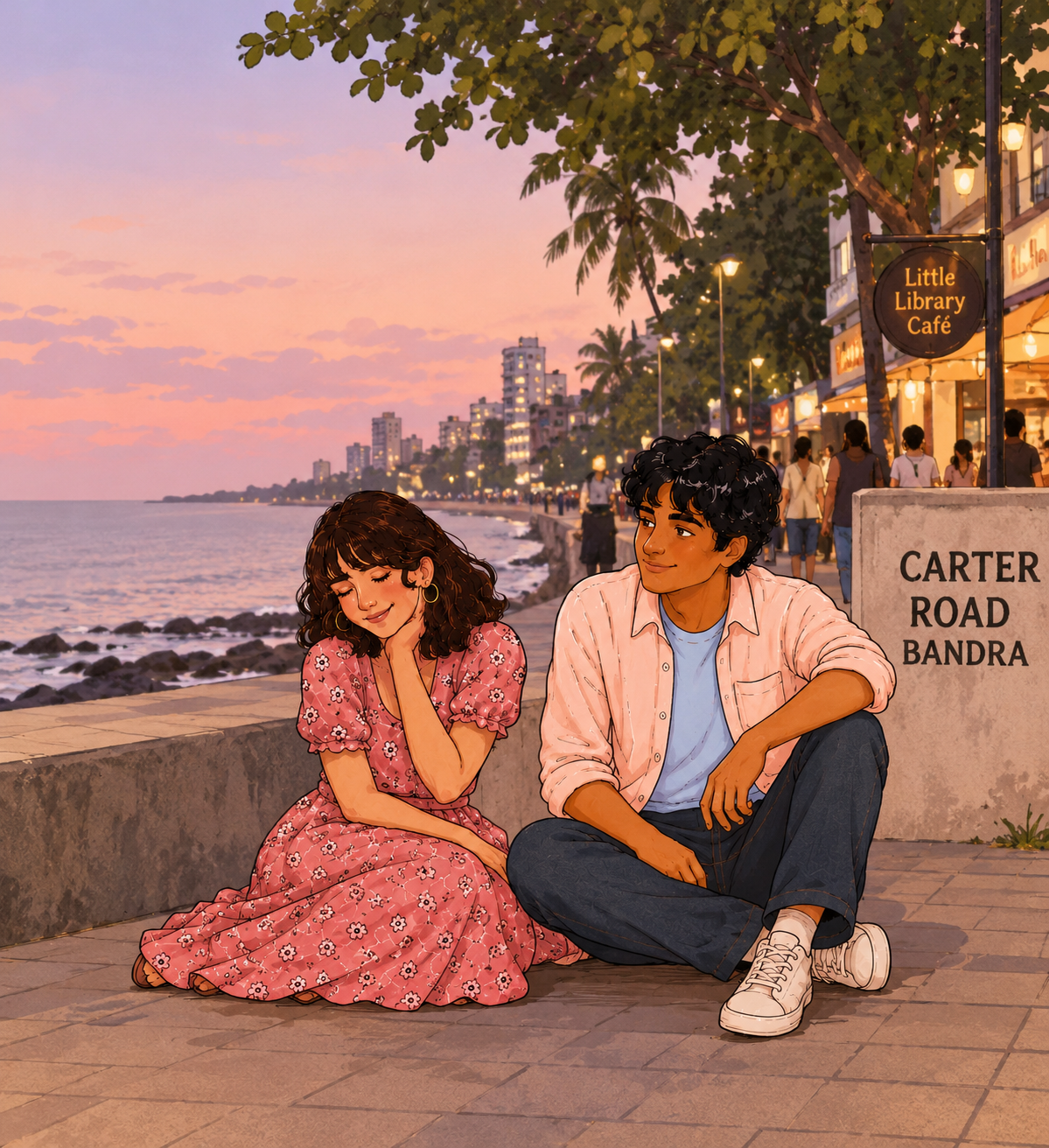
The story follows Adi, an aspiring writer working a marketing job in Mumbai, who spends most of his evenings at a library café overlooking Carter Road in Bandra.
He has an unfinished manuscript, a predictable coffee order, and a routine that has become almost impossible to break.
Then he notices a girl across the road.
She carries a book and, occasionally, a yellow umbrella. He doesn’t know her name or anything about her. But something about the way she stands by the sea catches his attention.
It is a rather ordinary observation, except that it does something his unfinished manuscript hasn’t managed to do in months.
It gives him something to write about.
In the chapter Yellow Against Grey, Adi watches the girl standing in the rain and begins writing again. He doesn’t know who she is, and he certainly doesn’t imagine that this brief observation will eventually become the beginning of an entire love story.
The girl is Fatima.
And their connection doesn’t begin with a conventional introduction.
It begins with a book left behind.
Anonymous Notes, Borrowed Books and the Beginning of Something Unexpected
One of my favourite ideas in the novel is the way Adi and Fatima begin communicating.
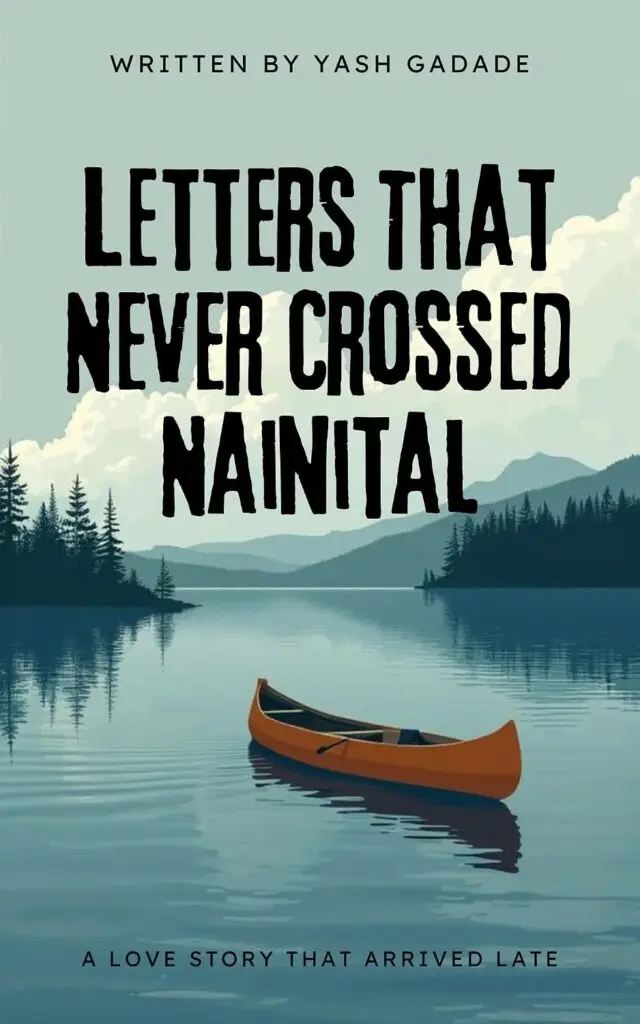
In The Book Left Behind, Adi comes across a note Fatima has accidentally left inside a borrowed book. It gives him a small glimpse into her life, her grandmother Ba, and a possible career opportunity in Bangalore.
He responds with a note of his own.
“Some books are worth finishing slowly. I hope you get an evening that lets you.”
It’s a small message. Nothing particularly dramatic. But it becomes the beginning of an exchange neither of them initially understands.
Over the following weeks, they continue leaving notes inside borrowed books. They share opinions, observations, personal thoughts and little pieces of their lives without immediately knowing who is on the other side.
Eventually, in No Names, Still, the two finally find themselves sitting across from each other.
Fatima recognises the unsigned notes. Adi recognises her opinions.
And suddenly, the person they have been getting to know through written words is sitting right there.
I particularly liked writing this part because it explores something we don’t always give enough attention to in romance: the excitement of getting to know someone’s mind before getting to know their entire life.
It’s a different kind of introduction.
And if you’ve ever enjoyed the anonymous communication in You’ve Got Mail or the emotional connection in The Lunchbox, you’ll probably understand why this particular part of the story matters.
From Jai and Aditi to Adi and Fatima: Different Stories, Familiar Feelings
Now, I wouldn’t say Adi and Fatima are another version of Jai and Aditi. Their stories are quite different.
Jaane Tu… Ya Jaane Na explores the complicated territory between friendship and romantic love.
The Café Across Carter Road explores what happens when two people begin connecting without knowing each other’s identities, gradually becoming part of each other’s lives through books, conversations and shared places.
But there is a familiar emotional thread between them.
Both stories understand that relationships are rarely as straightforward as we would like them to be.
In Adi and Fatima’s case, the relationship develops through ordinary experiences.
There is their afternoon exploring Pali Village, where Fatima introduces Adi to the neighbourhood and shares parts of her childhood.
There is The Long Black at Subko, where coffee becomes an excuse to spend another Sunday together. Their conversations become more personal, and Adi opens up about his struggles with writing.
Then comes Marine Drive at Night, where the two sit facing the water, discussing ambitions, the future and the decisions that have shaped their lives.
Nothing extraordinary happens in these moments.
And that’s precisely why they matter.
They are the kinds of evenings people remember years later, sometimes without realising how important they were when they actually happened.
Mumbai Is More Than Just the Setting

Another reason I wanted to write this story was Mumbai itself.
There are plenty of romance stories set in cities, but I wanted Bandra to feel like a place where the characters genuinely lived, rather than a collection of recognisable locations added for atmosphere.
Carter Road becomes part of Adi’s routine. Pali Village becomes a place where Fatima shares her memories. Subko becomes their regular coffee stop. Marine Drive becomes the setting for conversations that neither of them would necessarily have had elsewhere.
Even the small details matter.
The monsoon arriving unexpectedly. The local train in the distance. Coffee going cold while a conversation continues. The familiar walk home after an evening that neither person wants to end.
If you’ve watched Wake Up Sid, you might understand what I mean when I say that a city can sometimes feel like another character in a romantic story.
Mumbai has its own rhythm. It is crowded, impatient, occasionally exhausting, but also full of unexpected encounters.
And sometimes, somewhere between the traffic and the sea, two people find a reason to slow down.
Because Falling in Love Isn’t the Only Difficult Part
Of course, no relationship exists in isolation.
As Adi and Fatima become closer, their individual lives begin demanding attention too.
Fatima has her responsibilities towards Ba, her grandmother, and her own ambitions as an illustrator. Adi is still trying to find his place between a stable career and his desire to become a writer.
Their relationship eventually faces decisions that neither can simply solve with affection.
The café that brought them together is eventually forced to close. Fatima receives an opportunity elsewhere. Distance enters their lives, and the things they once took for granted become increasingly difficult to maintain.
The chapters An Offer From Elsewhere, What We Did Not Say and The Last Evening explore this change.
Later, in The Distance Between Two People in the Same City and How Two Years Happen Without Anyone Deciding, the story moves into a different emotional territory.
It is no longer just about getting to know someone.
It is about what happens when two people who have become important to each other struggle to find their way back.
I think this is where the story moves beyond the familiar feel-good romantic comedy formula.
Because falling in love is one thing. Learning how to make room for another person in the life you’ve already built is quite another.
The Yellow Umbrella: Sometimes, the Smallest Things Become the Biggest Memories

There is a reason the yellow umbrella appears throughout the story.
It is the first thing that makes Adi notice Fatima. It becomes an image associated with the beginning of their relationship, their memories and everything that follows.
By the time we reach The Yellow Umbrella, the story has come full circle.
The café, the books, the conversations and the places that once seemed ordinary have acquired an entirely different meaning.
And perhaps that’s what I wanted readers to take away from the novel.
We often remember relationships through very specific things. A particular song. A coffee order. A street we used to walk down. A book someone once recommended. An umbrella someone carried on a rainy evening.
We might forget entire conversations, but remember the smallest details with surprising clarity.
That, to me, is one of the nicest things about writing romance.
You get to take something ordinary and give it a place in someone’s memory.
So, Who Should Read The Café Across Carter Road?
If you enjoyed Jaane Tu… Ya Jaane Na for its warmth and its understanding of relationships, you might enjoy the quieter emotional journey of Adi and Fatima.
If Wake Up Sid made you fall in love with Mumbai’s everyday charm, you’ll probably appreciate the way Bandra and its neighbourhoods shape this story.
If you loved The Lunchbox for its understated emotional connection, the anonymous notes exchanged through library books might be right up your alley.
And if Before Sunrise made you believe that an evening of good conversation can be more memorable than an elaborate romantic gesture, there’s something here for you too.
The Café Across Carter Road is for readers who enjoy contemporary Indian romance, slow-burn relationships, creative characters, cosy cafés, books, monsoon evenings and the kind of love story that takes its time.
It is also a story about unfinished manuscripts, difficult decisions, family, ambitions and the places that quietly become part of who we are.
A Little More Than a Love Story
I think the reason we keep returning to films like Jaane Tu… Ya Jaane Na is that they remind us of a version of love that feels familiar.
Not perfect. Not always sensible. Sometimes confusing, sometimes funny, but ultimately human.
And perhaps that’s what I wanted to explore with The Café Across Carter Road.
A story where a writer finds inspiration in a stranger, where two people discover each other through books, and where a city becomes the backdrop to memories they never expected to make.
I won’t tell you how everything unfolds. That’s something I’d rather leave for you to discover.
But if you’ve ever sat in a café a little longer than necessary because you were enjoying someone’s company, or found yourself revisiting a street because it reminded you of a person, you might find something familiar in these pages.
Because sometimes, the best love stories don’t begin with a grand introduction.
Sometimes, they begin with a book left behind.
And sometimes, all it takes is a yellow umbrella across Carter Road.
The Café Across Carter Road by Yash Gadade
A contemporary Mumbai romance about books, anonymous notes, unexpected connections and the places that become part of our love stories.
If this sounds like your kind of read, you can find the book here:
[Read on Kindle – Amazon]
[Get the Paperback]
And if you do read it, I’d genuinely love to know which chapter stayed with you the longest.