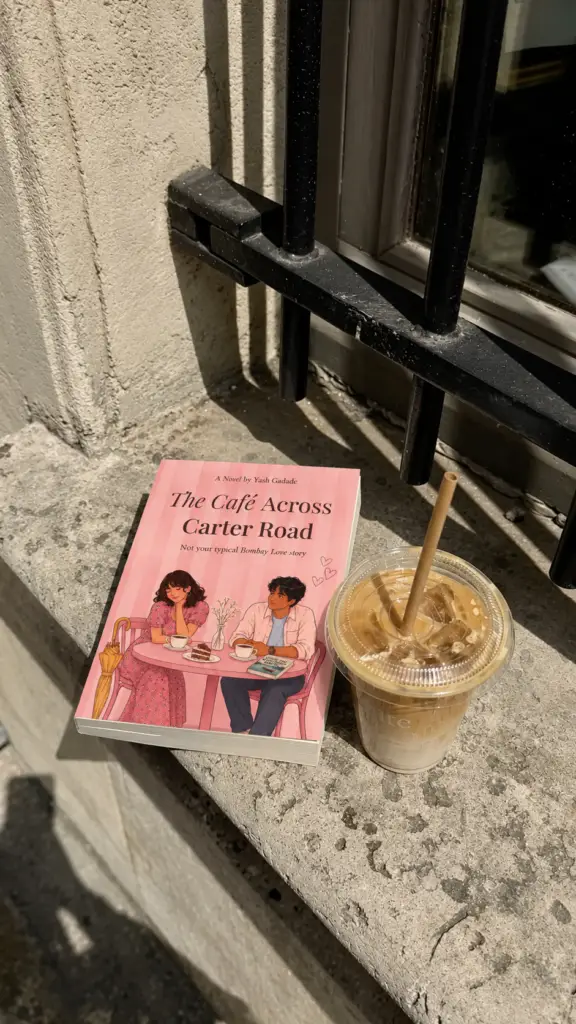
Why does the love story begin without names?
Adi and Fatima connect through anonymous notes, and the book’s chapter titles say it plainly: “Stories Without Names” and “No Names, Still”. Before a surname arrives, they simply see each other. Then the world’s questions arrive with the name: who are your people, what is your faith, what will your family say?
In one of the book’s quietest scenes, Fatima gives her full name. She explains that her mother was Parsi, that her father is Muslim, and that their marriage cost him dearly with his own family. Adi, who has spent the whole book falling for her, feels the ground shift.

Is the conflict in the book political?
No. When Adi tells his father, a temple priest in Pune, that he plans to marry Fatima, the pressure comes from family and community, the oldest and most intimate kind. His mother explains that the news threatens the way his father has built his identity. Nobody in the story is a villain. They are frightened, proud and attached to the shape of their lives.
That is why the novel works as a love story based in Mumbai: it shows how two people cross a line the world draws, with patience and grace and without a single speech.
What is Mumbai’s Freedom of Religion Act, 2026?
The Maharashtra Freedom of Religion Act, 2026 was passed by the state assembly in March 2026 and, according to reports, was notified to come into force on 28 August 2026. It regulates what it defines as unlawful conversion. Reports say a first offence can bring up to seven years in prison and repeat offences up to ten, and that anyone wishing to convert voluntarily must give the District Magistrate a declaration at least 60 days in advance.
What the government says
Chief Minister Devendra Fadnavis has said the law is not directed against any religion and is not meant to prohibit voluntary conversion or interfaith marriage. Officials describe such laws as protection against fraudulent conversion and a safeguard for young women. Supporters add that the law punishes force, fraud and inducement, not love.
What critics argue
Critics argue that the law creates a chilling effect on consensual interfaith relationships. A marriage found to be conducted solely for unlawful conversion can be declared void, and one legal analysis notes the Act’s definition of “allurement” is broader than in other states. Rights groups have also pointed out that complaints under similar laws often come from family members rather than the people directly involved, and one report cites Uttar Pradesh registering 835 cases and 1,682 arrests under its law through July 2024. More than 30 rights groups held a press conference in Mumbai in March over the draft law. Critics see all this as part of a wider pattern of Hindu-Muslim politics, a characterisation the government and its supporters reject.
Would Adi and Fatima’s story be different in Mumbai today?
By the government’s own reading, Adi and Fatima are not covered by the Act. They never plan a conversion, and nothing in their story involves force, fraud or inducement. They would still be two consenting adults.
The critics’ concern is about atmosphere rather than the letter of the law. It asks what happens when a relative’s objection can carry legal weight, when a notice or a neighbour’s whisper turns a private decision into a public one, and when two people who only wanted to read, write and love each other start to feel watched. Would the love story still have happened? Almost certainly, because love in this city has always found a way. The question is what it would cost.
Why does this book fit the moment?
The Café Across Carter Road doesn’t lecture and never names a law or a party. It offers a picture of Mumbai as a city of shared umbrellas, prasad passed between strangers during Ganpati, fish curry in Dadar and long evenings on Carter Road. For readers who worry what a name can cost, it shows how much a name can carry and how little it should have to prove.
If you are looking for a Bandra love story or a book based on Bandra that cares about both romance and belonging, this is the one to read.
How to buy book?
It’s availabe on google books as well as on Amazon Kindle