Table of Contents
I’m writing this the way you’d talk to a friend at midnight, so forgive the lack of a tidy structure. Love is not tidy. Anyone who tells you they’ve worked it out is either lying or between relationships.
The short version: hearts get broken because love needs more than two people who care. It also needs good timing, honest communication, a similar sense of where life is going, and sometimes the permission of families and communities. When one of these is missing, love can be completely real and still not work.
Here’s the long version, with a few books and films that said it better than I can.
Why do hearts get broken even when the love is real?
This is the question underneath all the others. We grow up believing that if the feeling is strong enough, everything else will sort itself out. Films tell us that. So do songs, and most of the books I loved at nineteen.
It turns out feeling is only one ingredient. You can love someone completely and still want a different city, a different life or a different pace. You can be loved back completely and still not be chosen. Nobody has done anything wrong in those stories, and that’s what makes them so hard to get over. There’s no villain to be angry at.
Tennyson’s famous line says it’s better to have loved and lost than never to have loved at all. I believe that on good days. On bad days I’d like a word with Tennyson.
Can you really not be with the person you love?
Sometimes, yes. That’s the sentence nobody wants to read.
And for the first time in longer than I could properly remember, I believed, completely, that some stories really were worth finishing slowly – From the book “The Cafe Across Carter Road”
The cruel part is that “the person you always loved” often turns out to be a mix of the real person and the version we built in our heads. We keep the good days on loop and edit out the rest. I’m not saying the love was fake. I’m saying part of what we mourn is the future we’d already furnished.
Casablanca gets at this better than almost anything. Rick and Ilsa love each other and can’t stay together, and the film’s answer is a line about always having Paris. It isn’t a happy ending. It’s a grown-up one, where the love is real, the circumstances are bigger, and they both walk away with something and without something.
What does “right person, wrong time” actually mean?
It means two people who would work in another year, another city or another version of themselves, meeting in this one.
Jane Austen wrote the definitive book on it. In Persuasion, Anne Elliot is persuaded to give up an engagement when she’s young, and the novel picks up years later, with her still living with that decision. When Captain Wentworth finally writes to her, he says: “You pierce my soul. I am half agony, half hope.” That one sentence is every ex who ever almost said something.
One Day by David Nicholls does the same thing across two decades, checking in on Emma and Dexter on the same date each year, and never quite getting the timing right. Richard Linklater’s Before Sunrise and Before Sunset are the film version: two strangers click for one night in Vienna, agree to meet again, and spend most of the next decade not doing it.
I think timing is the most underrated reason love fails. It also hurts the most, because it’s the one reason with no moral. You didn’t do anything wrong. You were just early, or late, or busy becoming someone else.

Why do we fall for the wrong person?
Because the heart doesn’t read the brochure.
Sometimes the wrong person has our heart for reasons we can almost explain. They’re unavailable, so we try harder. They’re familiar, in a way that echoes something old. They’re a flicker of how we wish we felt about ourselves. Psychologists write about attachment styles for exactly this, though I’m no therapist and won’t pretend to be one.
500 Days of Summer is the film I’d point at. It tells you from the opening minutes that it isn’t a love story, and then watches a man discover that the girl he fell for was partly an idea he’d made up. Both people were being honest. One of them just wasn’t looking at the other.
I don’t think falling for the wrong person makes you foolish. It makes you someone who loved before you were sure. That’s a risk, and most of us take it more than once.
A Love Story You’ll Want to Keep With You
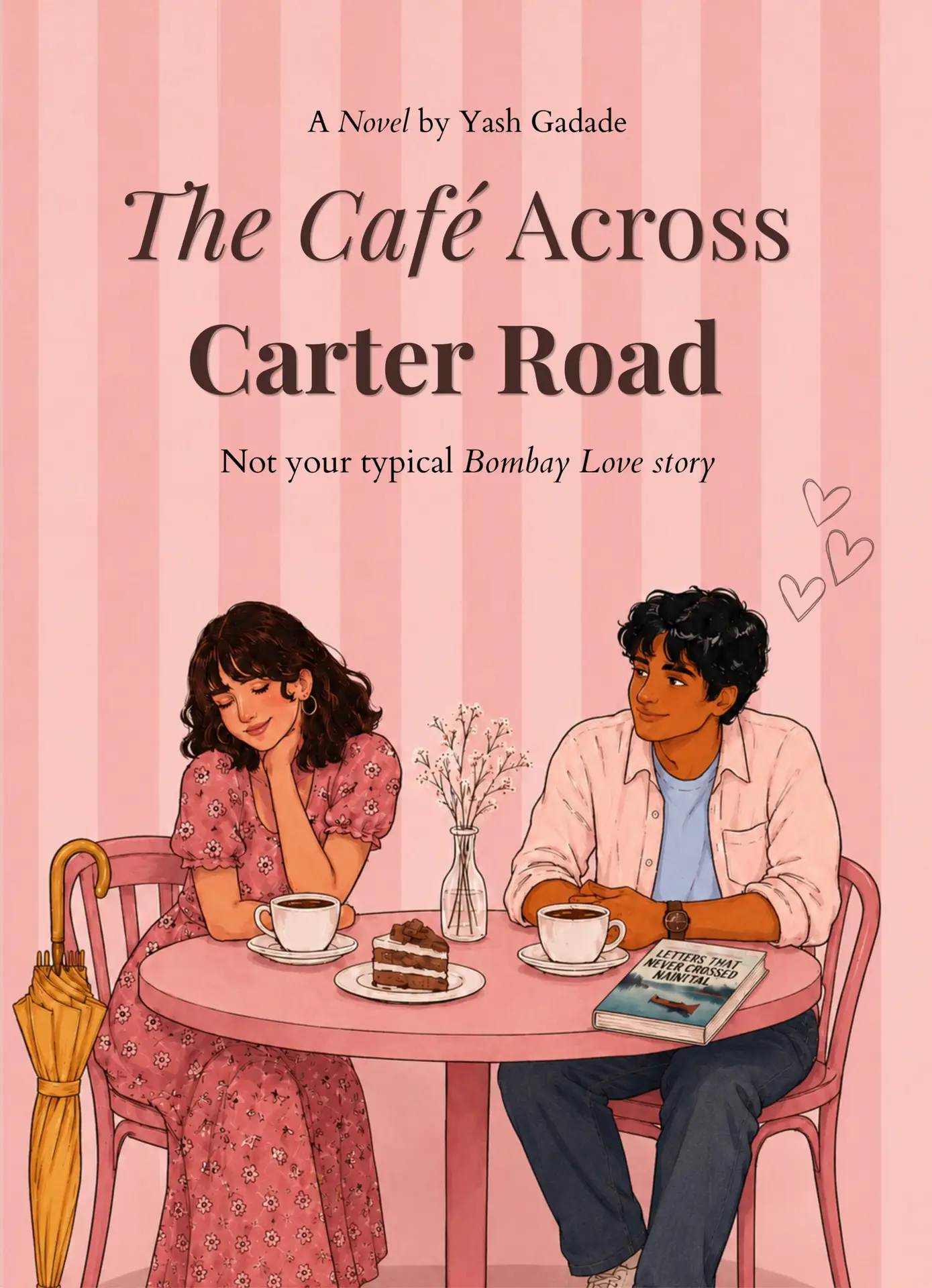
The Café Across Carter Road is a contemporary Mumbai romance about two strangers, a little library café, and the unexpected ways love finds its way into our lives.
Set against the streets of Bandra and Carter Road, this is a story of slow-burn romance, family, dreams, unfinished conversations, and finding someone who makes an ordinary city feel a little more like home.
When both people are good and it still doesn’t work
This one is my least favourite, and probably the most common. Trust me your boy is going through this as I am writing this section.
“Next time, I’ll wait. Even if you don’t come.” – from the book Letters That Never Crossed Nainital
Two kind, decent people who respect each other, and a life that points in two directions. One gets the job in another city. One has a family that needs them where they are. One wants to move fast and the other needs time. Nobody is wrong, and everybody is sad.
La La Land is the film that handles it with the most grace. Mia and Sebastian help each other become what they dream of, and the dreams are what pull them apart. Sally Rooney’s novel Normal People does something similar on the page, letting Connell and Marianne drift in and out of each other’s lives for years because neither quite manages to say the thing, even when they both know it.
I don’t have advice for this one. I just think it helps to know it’s a real category, and that “it didn’t work” is allowed to be a complete sentence.
Also Read: Even If You Don’t Come, I’ll Wait” — Nainital Lake Chapter Explained
How over-attachment ruins love
Here I’ll point at myself, and at most of the people I know.
Over-attachment is loving someone so tightly that you start to disappear. It looks like checking the phone, rereading old messages, needing an answer today, treating a quiet evening as a verdict. It comes from fear, which is why it’s hard to argue yourself out of. You grip harder because you’re afraid of losing the thing, and the gripping is what makes it feel like pressure.
Wuthering Heights is the darkest version in literature. Catherine tells Nelly she is Heathcliff, and the book spends hundreds of pages showing what happens when two people can’t separate. Saratchandra Chattopadhyay’s Devdas, first published in 1917, shows the quieter, sadder form: a man who can’t live with the loss, can’t fix it, and slowly destroys himself over it.
I’m not telling you to love less. I’m saying that holding on and holding tight are different things, and I’ve confused them more than once. If you’re in the middle of a heartbreak that feels bigger than you, talk to someone you trust, or to a professional. That’s not a weakness, and it’s usually the bravest thing in the room.
Caste, class and community: when the world has a vote
In India, and in plenty of other places, love doesn’t only happen between two people. It happens in front of families, communities, surnames, languages and, for many couples, caste.
For some couples these differences are small. For others they’re the whole story. Ek Duuje Ke Liye, from 1981, was about two young people separated by language and regional culture. Sairat, the Marathi film from 2016, is about a love that crosses caste and class lines in a village, and it doesn’t flinch from what that costs. Abroad, Austen’s Pride and Prejudice is a story about class where the couple wins. The Great Gatsby and Titanic are what it looks like when they don’t.
I find these the hardest to write about, because the obstacle is outside the couple. Two people can do everything right, and the world still holds a vote.
Books and films that sit with all of this
If you’re in the middle of any of the above, here’s a shelf worth visiting. Not as advice. Just as company.
- Persuasion by Jane Austen (right person, wrong time, a long wait)
- One Day by David Nicholls (timing across twenty years)
- Normal People by Sally Rooney (two good people, bad communication)
- Wuthering Heights by Emily Brontë (over-attachment at its darkest)
- Devdas by Saratchandra Chattopadhyay (love, class and self-destruction)
- The Great Gatsby by F. Scott Fitzgerald (class, and loving an idea)
- Before Sunrise and Before Sunset (timing, on film)
- La La Land (two people who are good for each other and still go separate ways)
- The Café Across Carter Road by me
I’m not putting myself level with Austen. I’m saying I wrote a book about the same ache, and I’d like it on the same shelf.
The book I wrote about exactly this
The Café Across Carter Road is a slow-burn Mumbai love story about Adi, a stuck novelist, and Fatima, a bookish illustrator, who fall for each other through anonymous notes left in library books in Bandra. It’s a gentle book on the surface. Underneath, it’s about almost everything in this post.
There’s timing: a job offer, a city that pulls one of them away, and chapters with titles like “An Offer From Elsewhere” and “The Distance Between Two People in the Same City.”
There’s the over-careful kind of love. In one scene Fatima asks Adi whether they’re both waiting for the other to speak first, and whether they’ll just keep having “lovely, almost conversations” for the rest of their lives. I suspect you know someone like that. You might be someone like that.
There’s fear. Adi admits to himself, “I was simply afraid,” that saying it out loud would make it real in a way that could then be lost.
There’s family and background too. Adi comes from a priestly family in Pune, Fatima has a Parsi mother and a Muslim father, and the book has a chapter called “The Names We Carry.”
And there’s distance. Part Four opens with the idea that “distance does not end love,” and that waiting is its own kind of devotion. I won’t say how it turns out, because the not-knowing is half the book.
It’s set across a Mumbai monsoon, on Carter Road, in Pali Village and on Marine Drive, so if you like stories with real places in them, you’ll be at home. You can read it on a Kindle or in the free Kindle app on your phone, and there’s a free sample if you’d like to meet Adi and Fatima before deciding.
Buy “The Cafe Across Carter Road” on Amazon: CLICK HERE
I don’t have a conclusion
I thought about ending this with something wise, and then I realised I’d be making it up.
I don’t know why some people get the love they want and some don’t. I don’t know if timing is luck or choice. I’m still working out whether I hold on too tightly, or not tightly enough. If you’re reading this at some odd hour with a name on your mind, I don’t have the answer for you either.
We’re all figuring it out. That’s the whole post.
Frequently asked questions
Why do hearts get broken even when the love is real? Love needs more than strong feelings. Timing, shared goals, communication, family and circumstances all play a part, so two people can love each other deeply and still not be able to stay together.
What does “right person, wrong time” mean? It means two people who could have worked as a couple at a different point in their lives, but whose circumstances, readiness or priorities didn’t line up when they met.
Why do we fall for the wrong person? People often fall for someone unavailable, familiar or idealised, sometimes because of attachment patterns formed earlier in life. It doesn’t mean something is wrong with you, but a therapist can help if the pattern keeps repeating.
Can over-attachment ruin a relationship? Yes. Holding on too tightly, through constant checking, needing reassurance or fearing every silence, can create pressure that pushes a partner away, even when the underlying love is genuine.
Can love survive caste, class or community differences? Some couples manage it and some don’t. The obstacle is often outside the relationship, in family expectations and social pressure, which is why these stories are so painful in fiction and in life.
What are good books about heartbreak and bad timing? Persuasion, One Day, Normal People, Wuthering Heights, Devdas and The Café Across Carter Road all explore heartbreak, timing or the things that keep people apart.
Is there a Mumbai love story about timing and distance? Yes. The Café Across Carter Road by Yash Gadade is a Bandra love story about two people who fall for each other through anonymous notes, and about what distance and timing do to them.